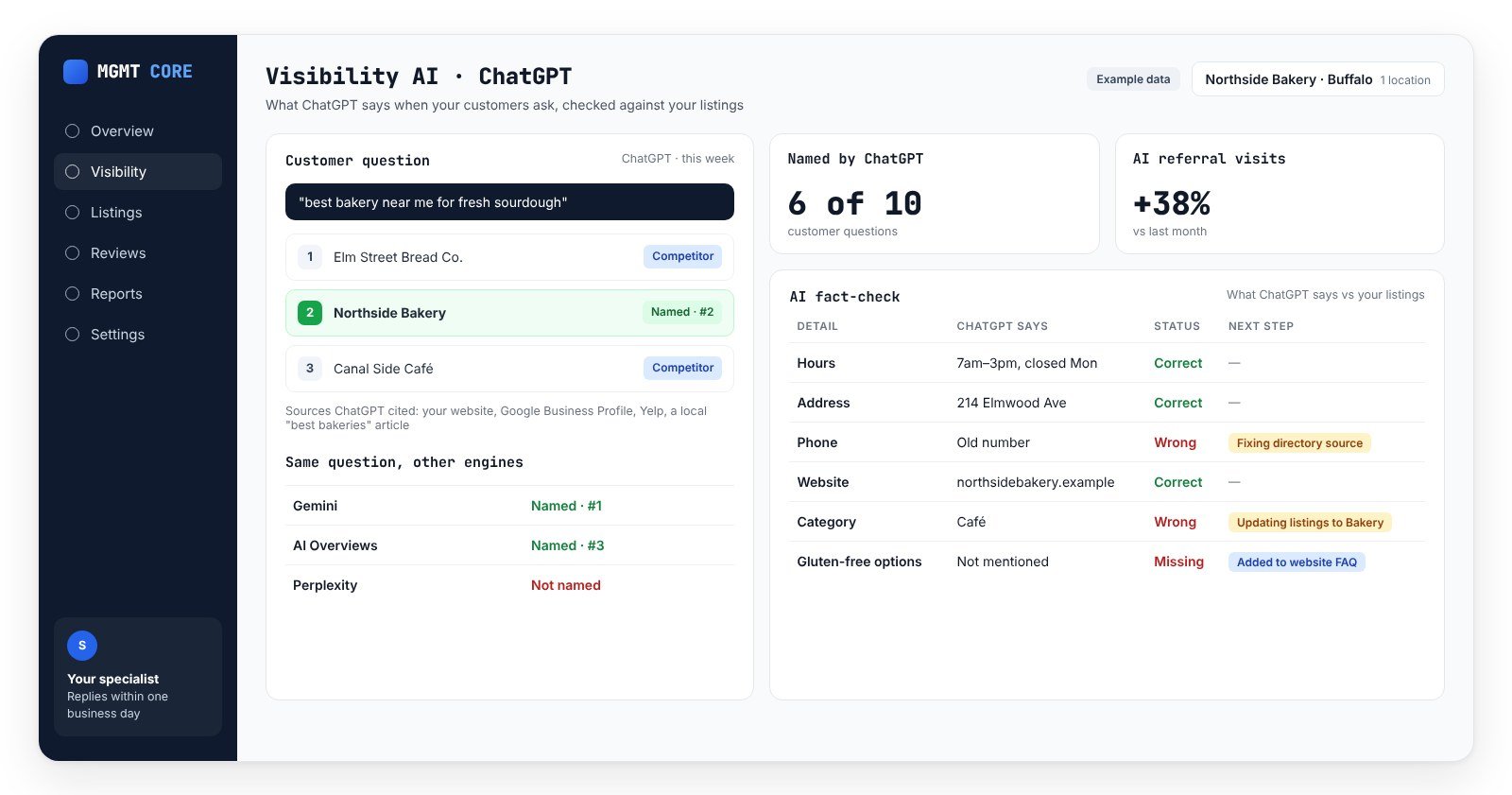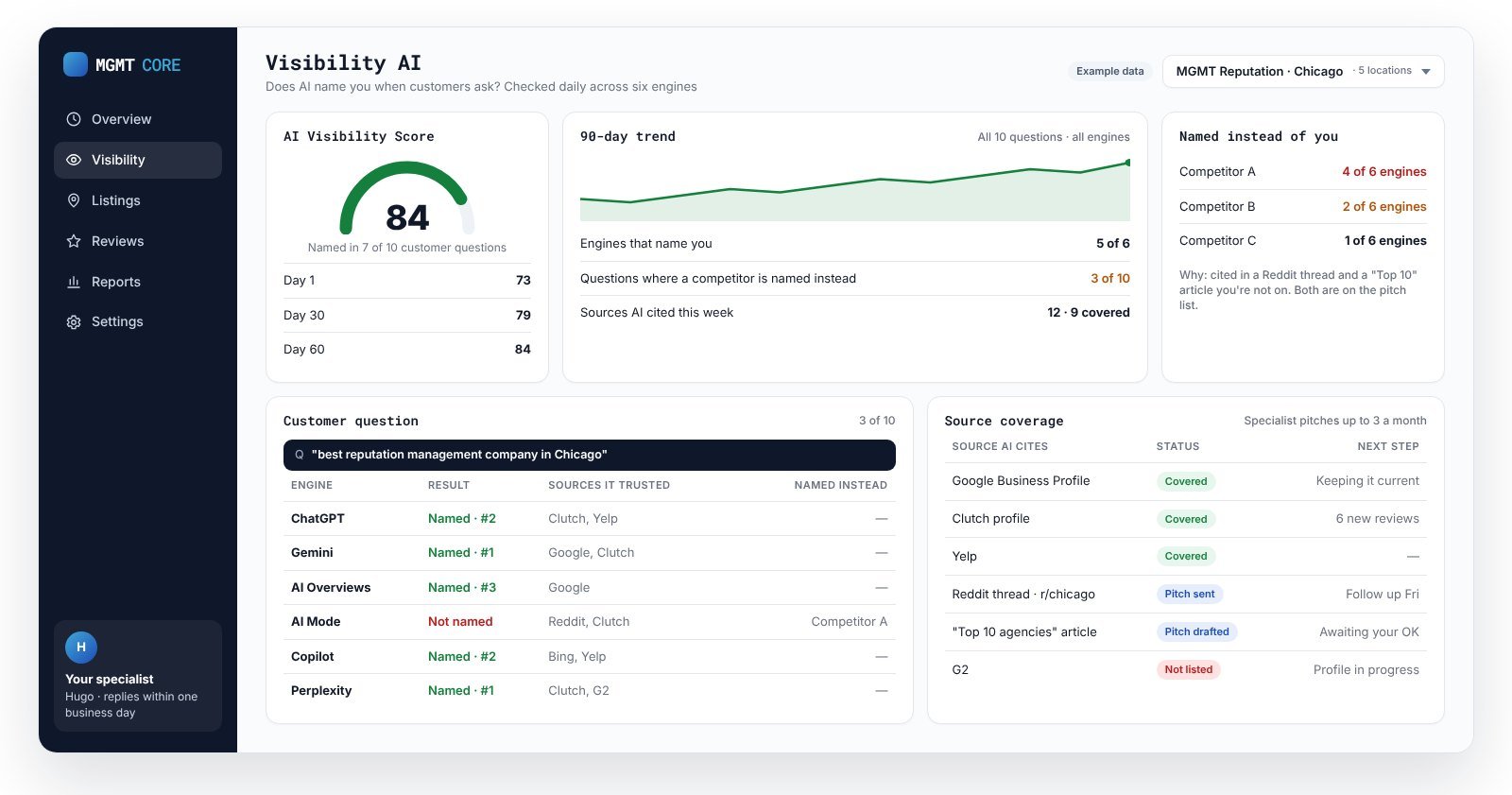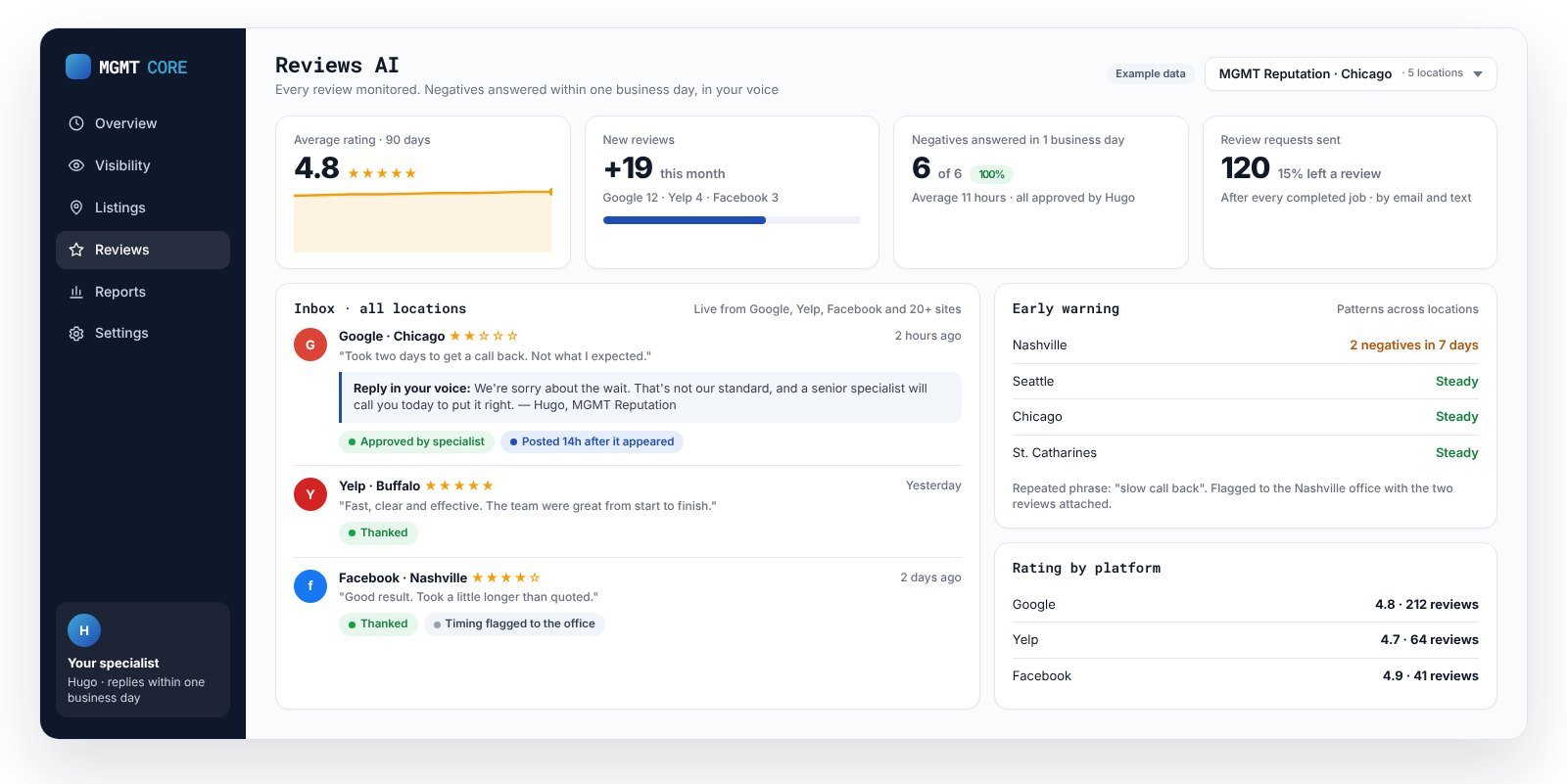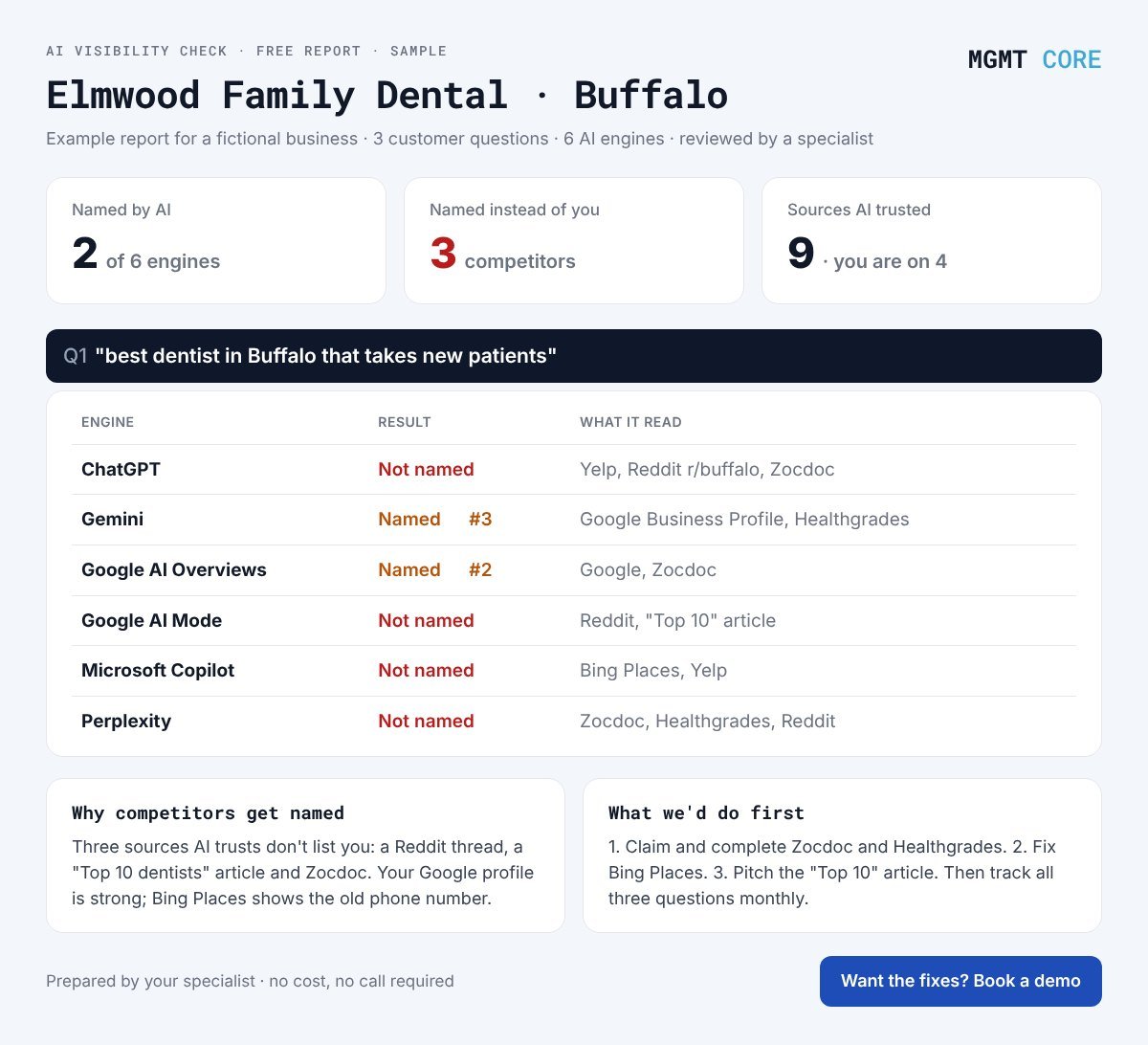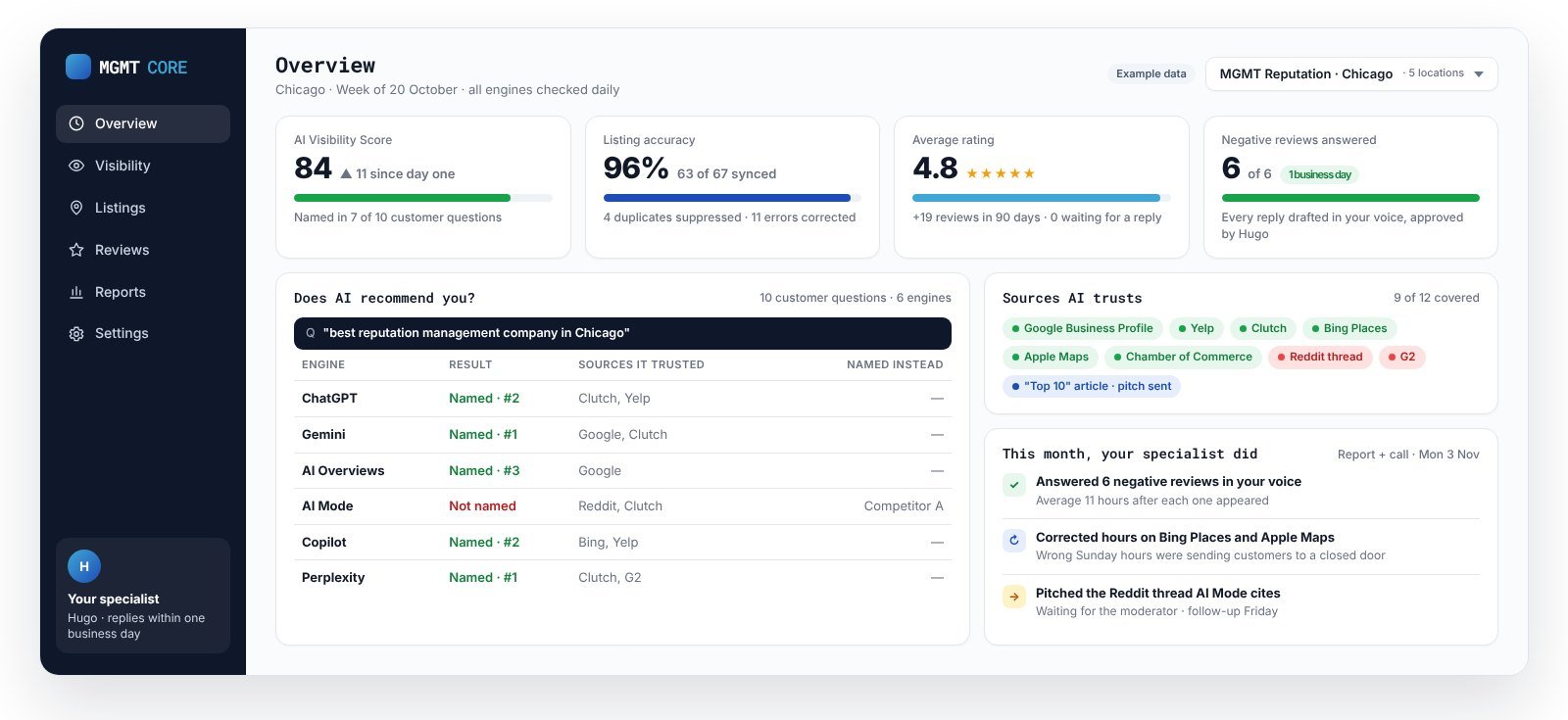
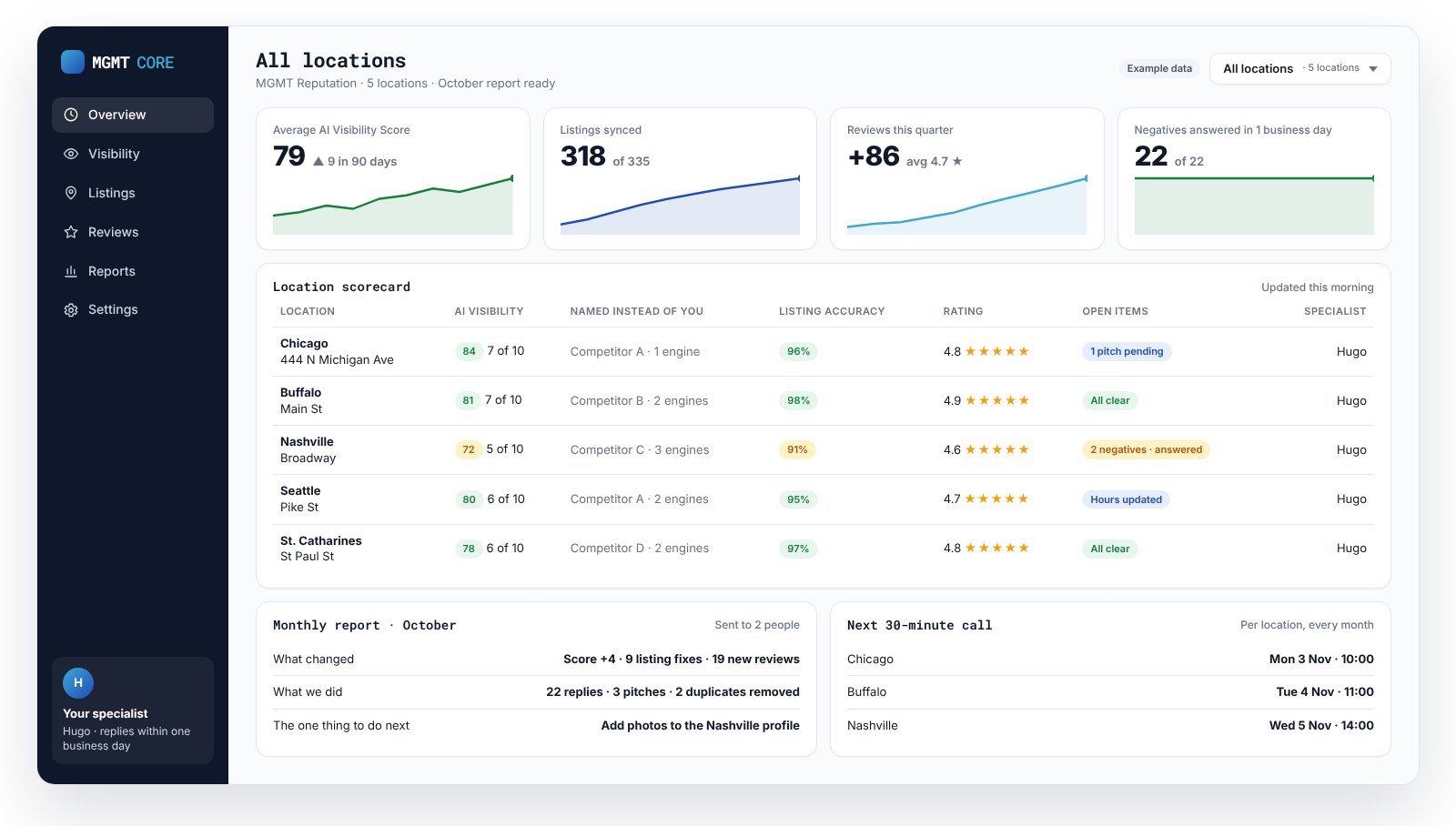
The short answer: a reputation intelligence platform collects what the public can see about your business, including reviews, listings, map position and what AI assistants say about you, for every location, and turns it into a short list of what to fix next. The “intelligence” is the second part. Plenty of tools collect data; fewer tell you what it means, and fewer still do the work.
What a reputation intelligence platform tracks
For a local or multi-location business, five public signals decide whether a customer picks you or the business down the street:
- Reviews. Every new review on Google and the other major review sites, the rating trend, and the complaints that keep repeating.
- Listings. Whether your name, address, phone, hours and categories are correct across the major directories, maps and GPS platforms, and whether duplicates are confusing customers.
- Local map position. Where each location shows on the map, street by street, for the searches that matter to you.
- AI answers. Whether ChatGPT, Gemini, Perplexity, Google AI Overviews, Google AI Mode and Microsoft Copilot name you when customers ask, and who they name instead.
- Sources. The directories, guides and “best of” lists that the AI engines and customers read before they decide.
Reputation intelligence platform vs reputation management software
Traditional reputation management software was built around reviews: collect them, reply to them, ask for more. A reputation intelligence platform widens the view to everything that shapes the decision, and puts it in one place per location.
| Reputation management software | Reputation intelligence platform | |
|---|---|---|
| Main focus | Reviews | Reviews, listings, map rank, AI answers and sources |
| Question it answers | “What are people saying?” | “Why are customers choosing someone else, and what do we fix first?” |
| AI assistants | Usually not tracked | Tracked engine by engine |
| Competitors | Sometimes | Who is named or ranked instead, per location |
| Output | Dashboards and alerts | A prioritised fix list and a monthly report |
Why the intelligence part matters
A dashboard that says “37 listings need attention, 12 reviews unanswered, AI visibility down 4 points” is data. Intelligence connects it: the AI engines keep citing one directory where your Chicago location has the wrong hours; a competitor with fresher reviews is named instead; fix the hours, answer the reviews, and pitch that directory. For a team running ten locations, that difference is the difference between a tool nobody opens and a plan someone acts on.
What to look for in a reputation intelligence platform
- Per-location views. Multi-location businesses need every number by location, with a roll-up for the brand.
- AI tracking across several engines. One engine is not enough; they often disagree. Ask which engines are checked and how often.
- Competitors named instead. The most actionable view in AI tracking.
- Source tracking. Which sites the engines cite, so you know where to be listed.
- Listings distribution, not only audits. Finding wrong details is half the job; pushing the fix to the publishers is the other half.
- Review replies with approvals. Drafts in your voice, approved before publishing.
- A transparent method. Every score should come with how it is calculated. Ours is on how we measure.
- People. Someone who reads the numbers and does the fixes. Software that only watches creates work instead of removing it.
- No promises of rankings or AI mentions. Nobody controls what the engines say. Be wary of anyone who guarantees it.
Who needs a reputation intelligence platform
It pays off most for businesses where customers choose locally and compare before they call: dental and medical practices, law firms, home services, auto dealers, restaurants, veterinary clinics and franchises. The more locations you have, the more you need one view, because the problems multiply quietly: a wrong phone number here, an unanswered review there, a competitor slowly becoming the name AI recommends in one city.
How to start without a platform
- Pick one location and check whether AI names it: how to check if ChatGPT recommends your business.
- Audit its listings against the multi-location listings checklist.
- Answer every open review using the one-business-day method.
- Write down the competitors and sources that keep coming up. That is your first fix list.
How MGMT Core works as a reputation intelligence platform
MGMT Core combines three engines per location: Visibility AI (six AI engines, competitors named instead, sources, a monthly AI visibility score), Listings AI (a network of up to 102 publishers, duplicates suppressed where the publisher allows, a map rank grid) and Reviews AI (every Google review answered in your voice, approved by your specialist). Software watches; a named specialist fixes what matters and walks you through a monthly report on a 30-minute call. It is $400 per location per month with no contract; see pricing or how it compares. Google explains how its AI features use web content in its guidance for site owners.
FAQs
Is a reputation intelligence platform the same as social listening?
No. Social listening tracks conversations on social networks. Reputation intelligence focuses on the signals that decide local choices: reviews, listings, maps and AI answers.
Does it remove negative reviews?
No. It monitors and answers them. Reviews can only be removed by the platform when they break its rules.
How much does a reputation intelligence platform cost?
Software-only tools range widely. MGMT Core is $400 per location per month, including the specialist, with a $199 setup fee and no contract.
How is AI visibility measured?
As the share of tracked answers that name you. See what an AI visibility score includes.
See your reputation intelligence for one location, free. Get a free AI visibility check, or book a demo.