The short answer: AI Overviews for local businesses are built from several related searches Google runs behind the scenes, drawing on pages and profiles it can already index and trust: your Google Business Profile, your website, directories, review sites and third-party lists. Locations with complete, consistent profiles, a steady flow of answered reviews and pages that answer the question plainly are easier for Google to name. There is no application form, and no way to pay for a place.
What AI Overviews are, and when they mention local businesses
AI Overviews are the generated summaries that sit above the classic results on some Google searches. Google AI Mode is the longer, conversational version of the same idea. Both can name businesses, link to them and summarise what other sites say about them.
They do not appear for every search. Google’s own documentation says AI Overviews show only when its systems judge they add something beyond the classic results, and that they often don’t trigger. Local questions with a decision in them (“which physio in Austin is best for sports injuries”, “family dentist open Saturdays near downtown Denver”) are the ones most likely to get a summary that names businesses.
That matters for multi-location brands because each location faces its own version of the question. A brand can be named in one city and missing three suburbs away.
How Google AI Overviews choose local businesses
Google describes the mechanics in its guide to AI features and your website. Three points from it explain most of what owners see:
- Query fan-out. To build an answer, AI Overviews and AI Mode may run multiple related searches across subtopics and data sources. A question about “the best dentist in Plano” can quietly become searches about reviews, opening hours, insurance and specific treatments.
- Supporting links come from the index. To be shown as a supporting link, a page must be indexed and eligible to appear in Search with a snippet. If Google cannot crawl or index a page, it cannot cite it.
- No special AI markup. Google says there are no extra requirements: no AI text files and no special schema. Normal search fundamentals apply, structured data should match what is visible on the page, and Business Profile information should be kept up to date.
Because AI Mode and AI Overviews can use different models and techniques, the businesses and links each shows for the same question can differ. Check both.
The 7 signals that shape AI Overviews for local businesses
Google does not publish a separate local formula for AI Overviews. What it does publish is how local results work and how AI features find supporting pages. Put together, these are the signals worth managing for every location:
| Signal | Where it lives | What to check per location |
|---|---|---|
| 1. Business Profile completeness | Google Business Profile | Verified, most specific primary category, services, attributes, hours and special hours filled in. |
| 2. Consistent details everywhere | Directories, maps, data aggregators | Name, address, phone and hours identical on every listing; duplicates suppressed. |
| 3. Reviews: volume, rating and replies | Google, plus Facebook, Yelp and industry sites | Steady new reviews, recent replies, no unanswered negatives. |
| 4. A crawlable page for the location | Your website | One indexable page per location with services, area served, hours and plain answers to common questions. |
| 5. Third-party mentions | “Best of” lists, local press, associations, directories | Which sources Google cites for your category and city, and whether you appear on them. |
| 6. Relevance to the exact question | Profile, site and reviews | Do your pages and reviews use the words customers use: the service, the area, the qualifier? |
| 7. Distance and context | The searcher’s location | Nothing to fix, but it is why answers differ point by point, so measure by location. |
Signals 1, 3 and 7 come straight from Google’s local ranking help page, which names relevance, distance and prominence as the three factors and lists review count, ratings and links from other websites as parts of prominence. Signals 2, 4, 5 and 6 follow from how AI features pick supporting pages: they can only cite what is indexed, and they draw on several sources to build one answer.
How to check whether AI Overviews name your locations
Run this once a week for each location, with the same questions each time, so the results are comparable.
- Write the questions. Three per location to start, in customers’ words: the service, the place and one qualifier. Our guide on how to check if ChatGPT recommends your business explains how to word them; the same list works for Google.
- Search from the right place. Use a private window and, where possible, a device in or near the location’s area, since distance changes the answer.
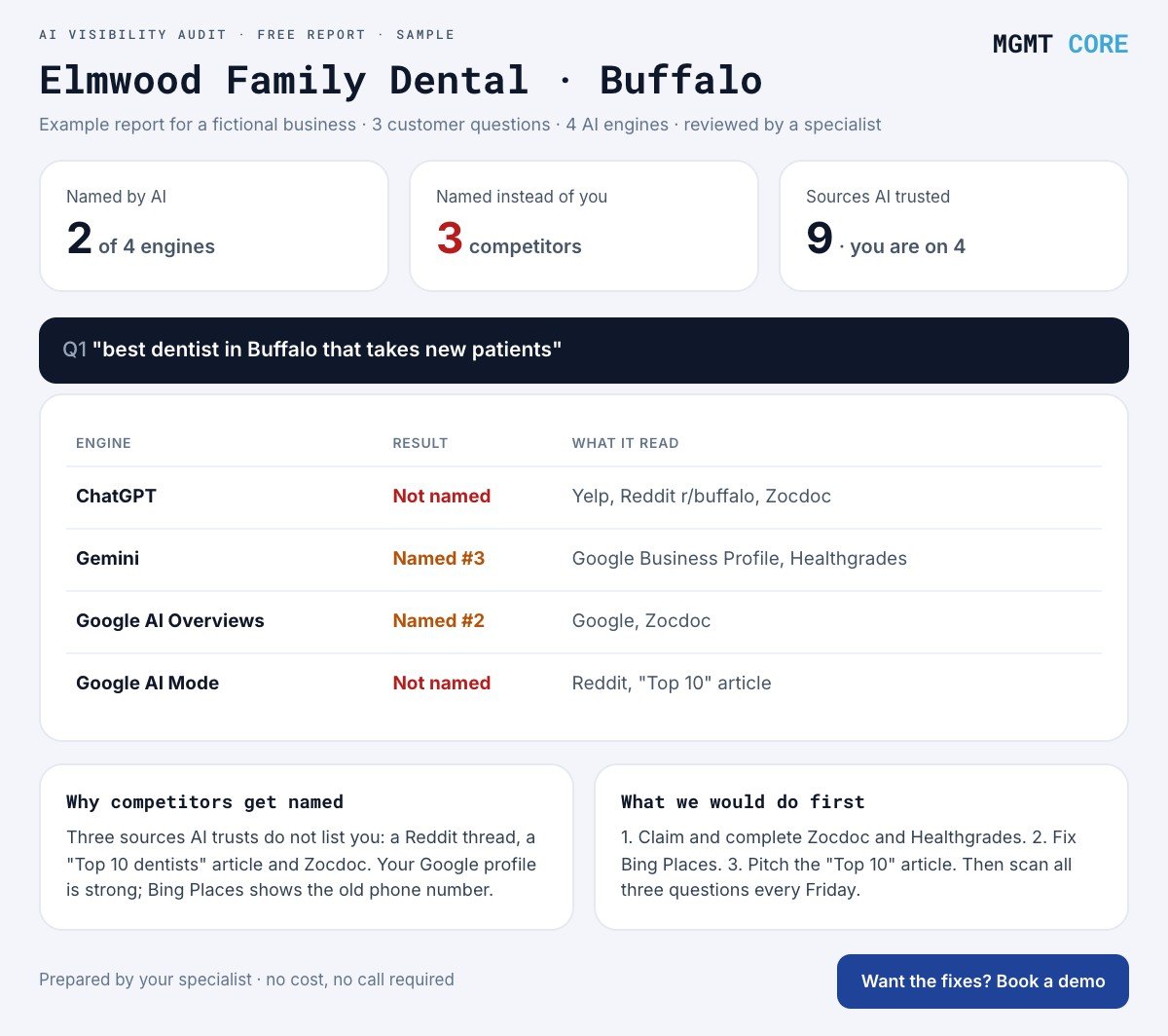
- Record what appears. Was there an AI Overview at all? Were you named? Who was named instead? Which links were cited?
- Repeat in AI Mode. Ask the same question in AI Mode and note the differences.
- List the sources. The cited domains are your to-do list: listings to correct, lists to get onto, pages to improve.
Checklist: improving AI Overviews for local businesses, one location at a time
- Fix the profile first. Verify every location, choose the most specific primary category, fill in services and attributes, and keep holiday hours current.
- Make the details identical. Work through the multi-location listings checklist so name, address, phone and hours match on every directory and map, and suppress duplicates.
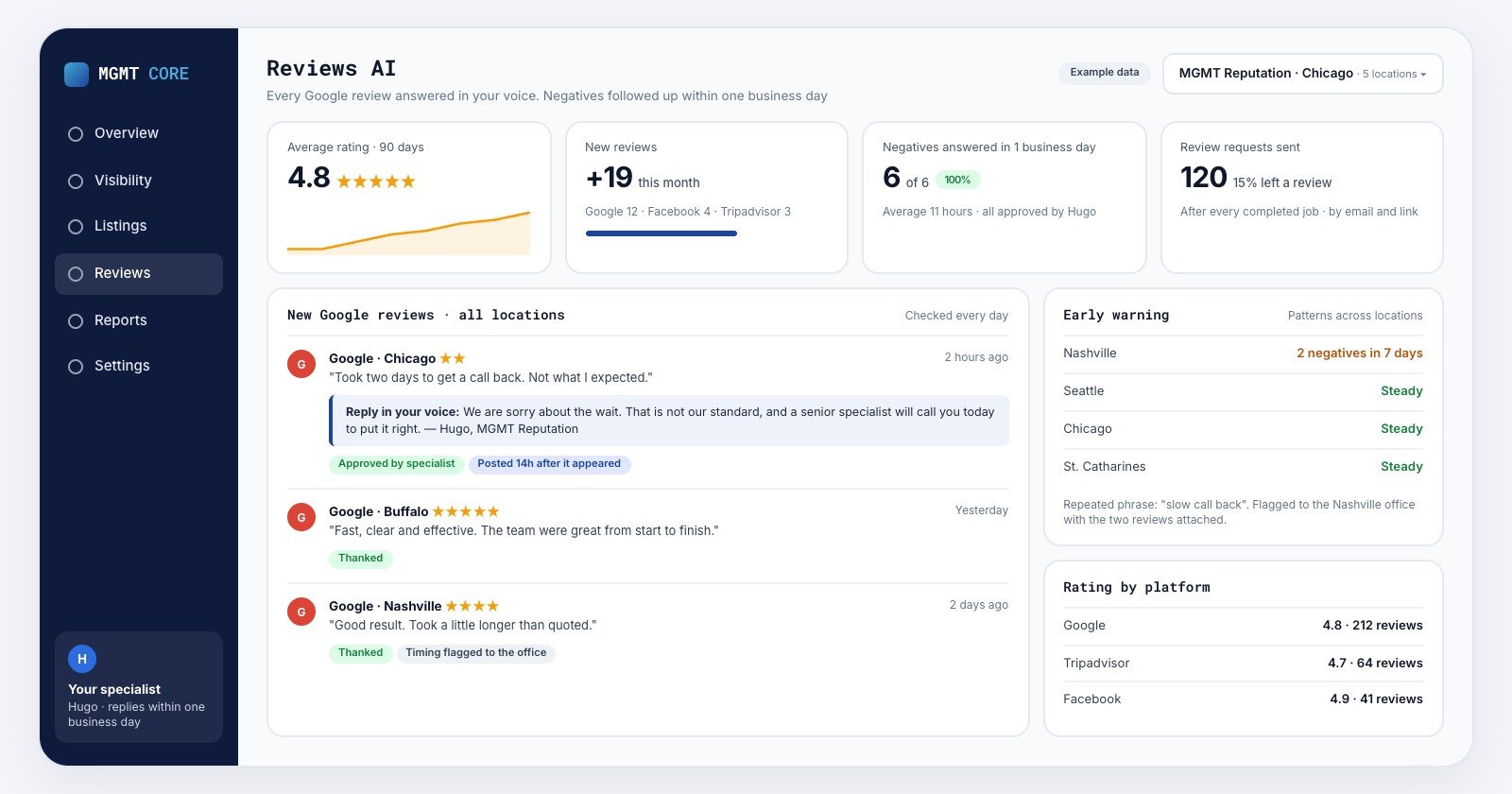
- Keep reviews coming and answered. Ask satisfied customers by email or link (see how to ask customers for Google reviews) and reply to every review, with negatives followed up within one business day.
- Give each location a real page. State the services, the neighbourhoods served, the hours and, where you publish them, prices. Answer the three or four questions customers ask most. Keep any structured data matching the visible text.
- Earn the cited sources. When the same local list, association or directory keeps appearing as a supporting link, make sure your listing there is accurate, and pitch the editor where it makes sense.
- Measure again next week. Changes take time to be crawled and reflected. Track the same questions so the comparison is fair.
Why AI Overviews differ from the map pack and classic SEO
The map pack ranks Business Profiles. Classic results rank pages. AI Overviews blend both, add what other sites say, then summarise. A location can sit third in the map pack and still be the one an AI Overview names, because a trusted local list or a run of detailed reviews mentions it. The reverse also happens. We cover the wider difference in AI visibility vs SEO.
Honest limits
No one can promise a mention in an AI Overview. Google does not publish a weighting, answers change from day to day and from street to street, and for many searches no AI Overview appears at all. What you can do is make every location easy to understand and easy to verify, then track whether it is named over time and which sources Google leans on. Treat single searches as anecdotes and weekly tracking of the same questions as the evidence.
How MGMT Core tracks AI Overviews for every location
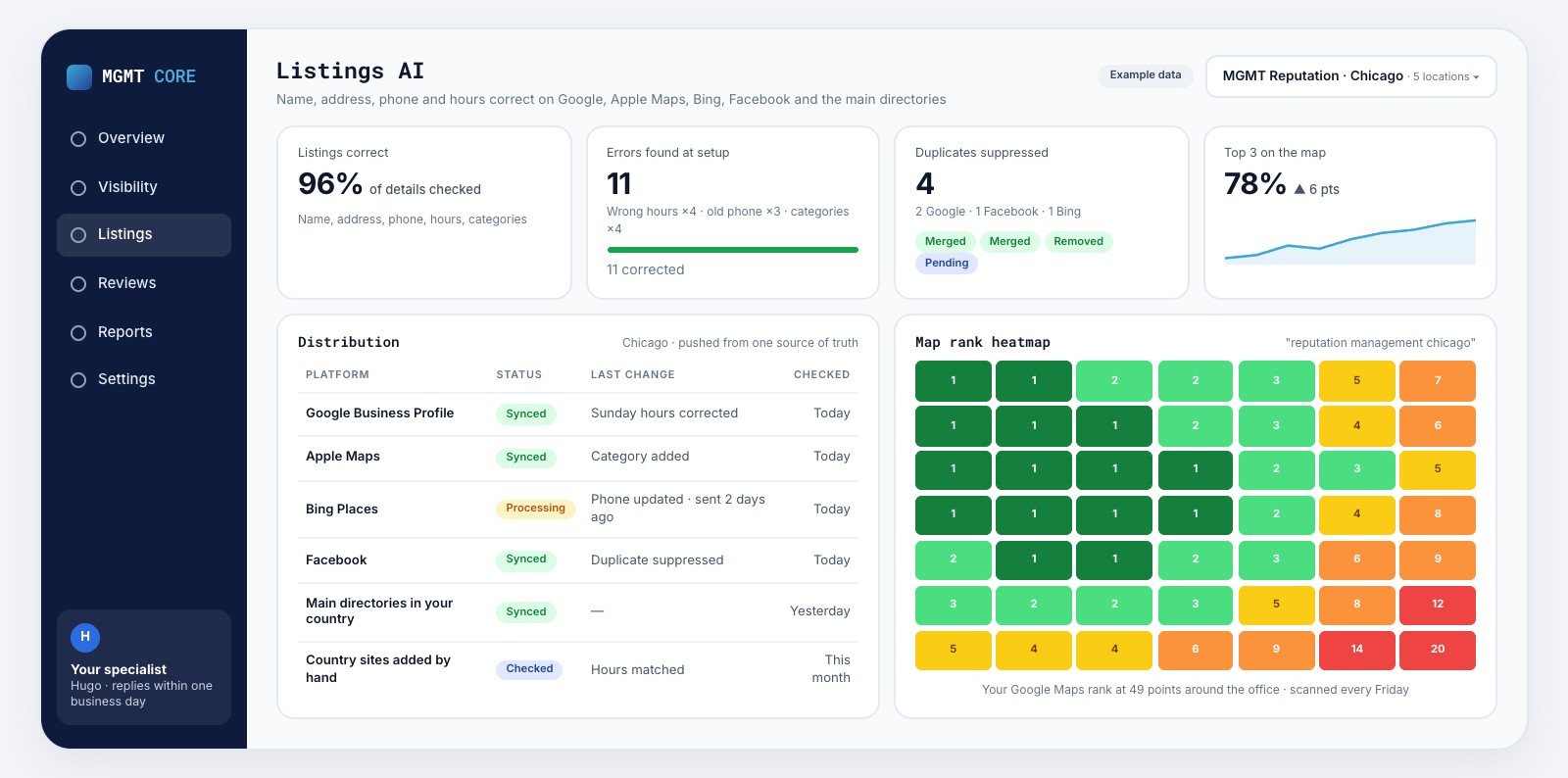
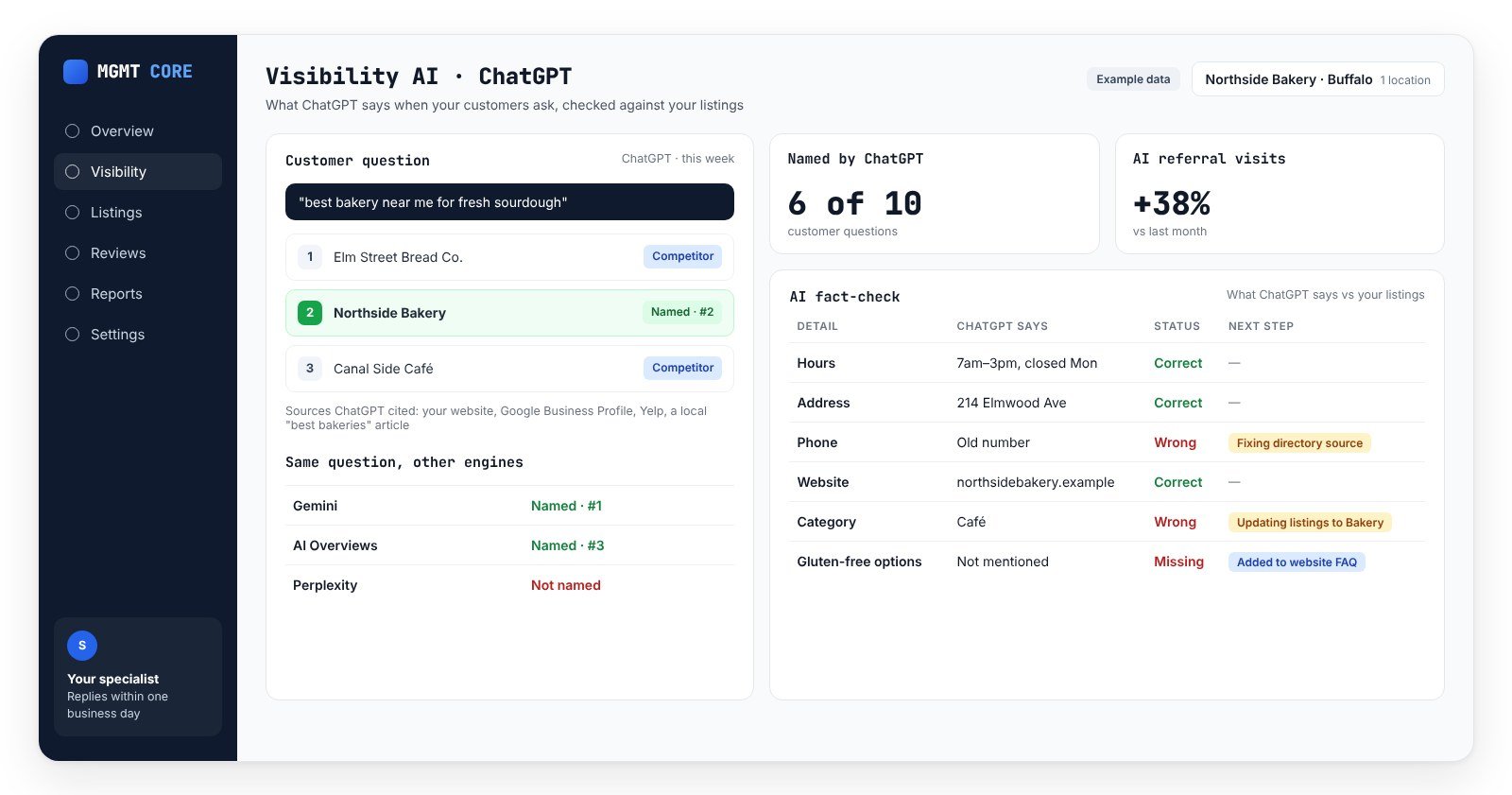
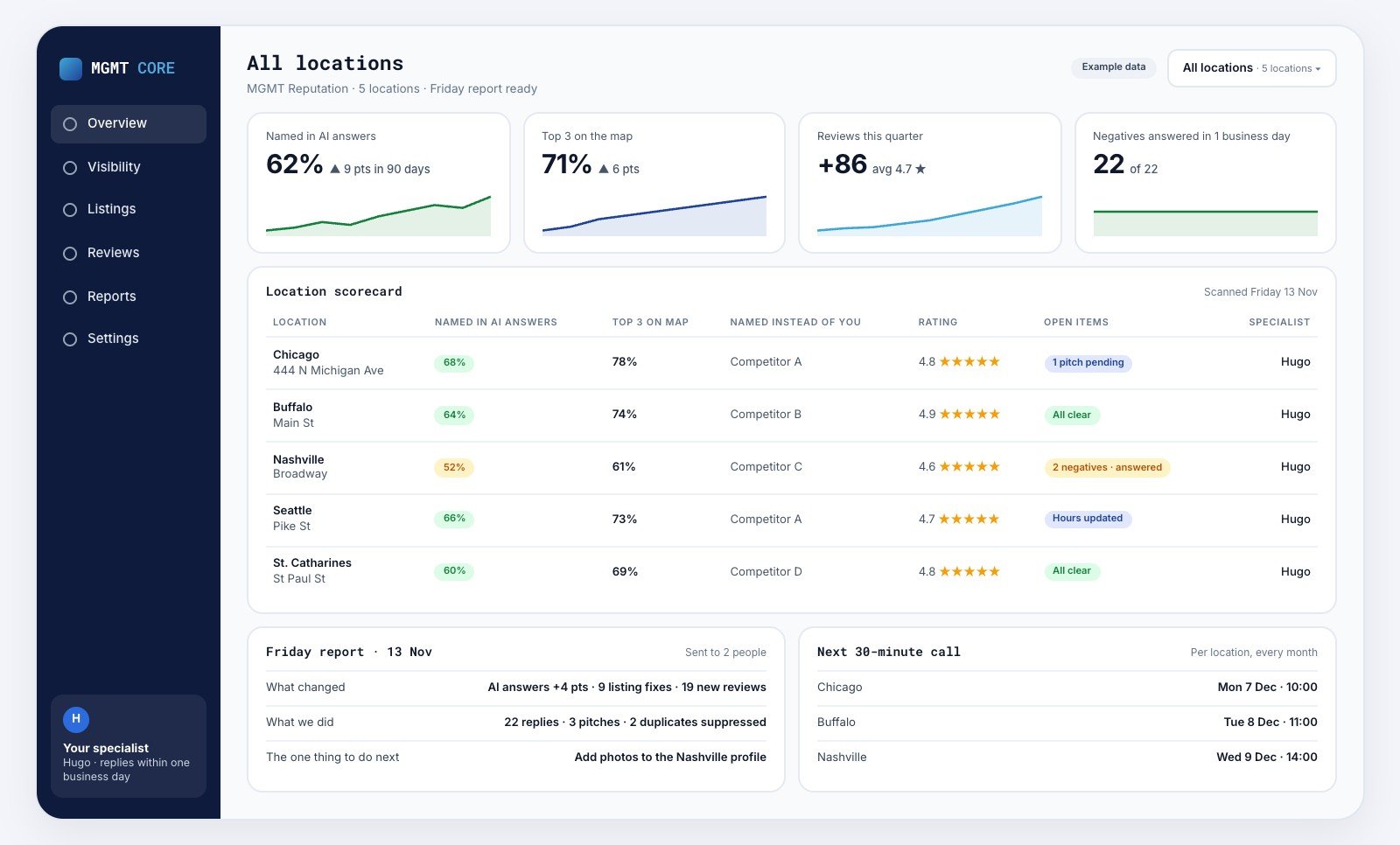
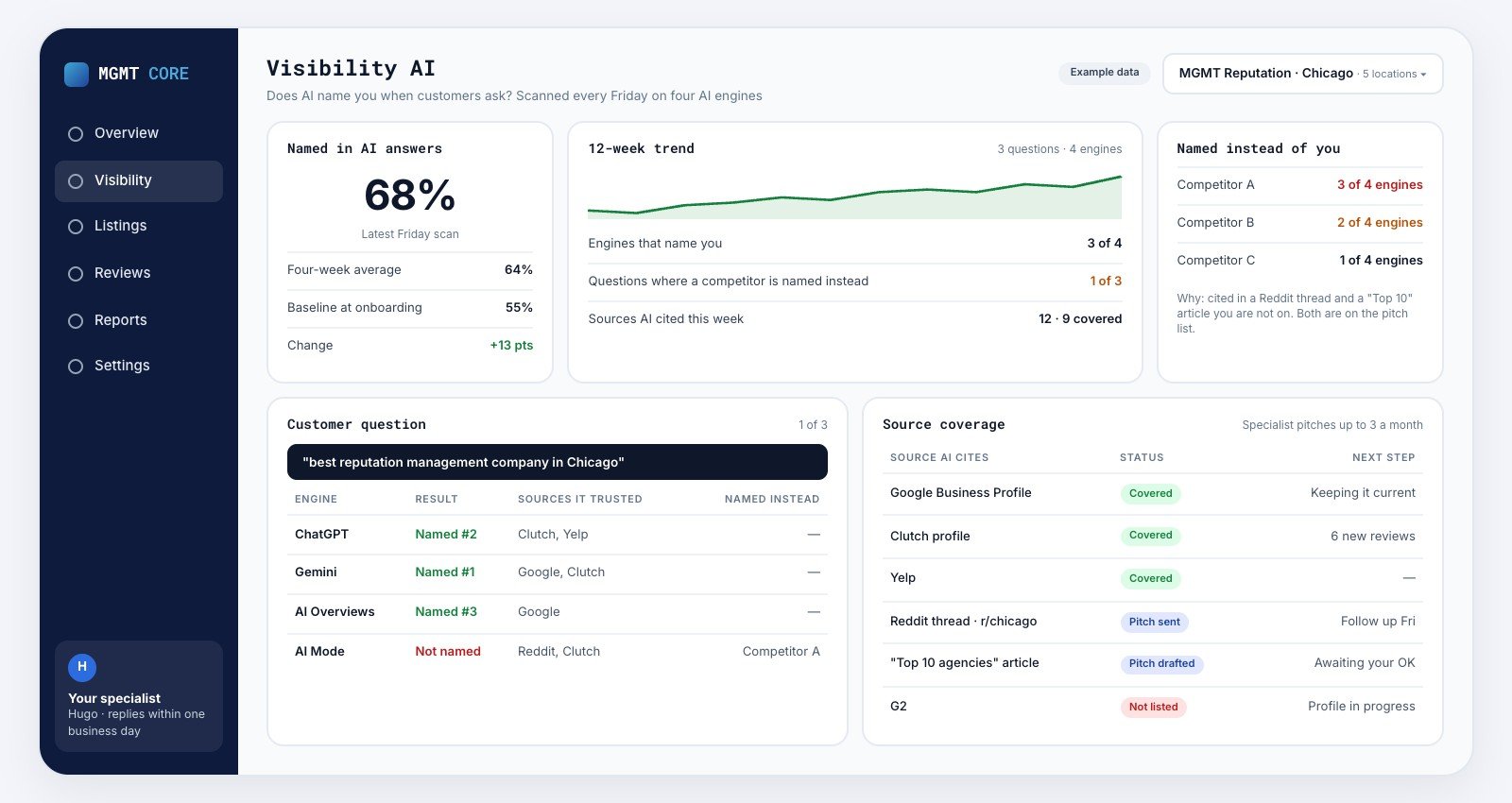
Visibility AI asks your top customer questions across four AI engines, including Google AI Overviews and Google AI Mode, and records who is named, who is named instead and which sources are cited. Listings AI and Reviews AI handle the profile, directory and review work behind those signals, and a named specialist walks you through the results on a 30-minute call each month. It is $400 per location per month, or $4,000 per year, with a $199 setup and no contract; see pricing.
FAQs
Can I pay Google to appear in an AI Overview?
No. Google states there is no way to request or pay for a better local ranking, and AI Overviews cite pages from the same organic index. The work is in your profiles, listings, reviews and pages.
Do I need special schema markup for AI Overviews?
No special markup is required. Google says there is no AI-specific schema; normal structured data is fine as long as it matches the visible content. LocalBusiness markup on each location page can make your details easier for Google to read.
Why does an AI Overview name a competitor with fewer reviews?
Reviews are one signal among several. The competitor may be closer to the searcher, have a page that matches the exact question, or appear on a local list Google cited. Check the supporting links to see which.
How often should a multi-location business check AI Overviews?
Weekly, per location, using the same questions each time. Single searches show noise; weekly tracking shows direction.
Want to see whether Google AI Overviews name your locations, and who gets named instead? Request a free AI visibility audit and we will send the report within 1 hour.